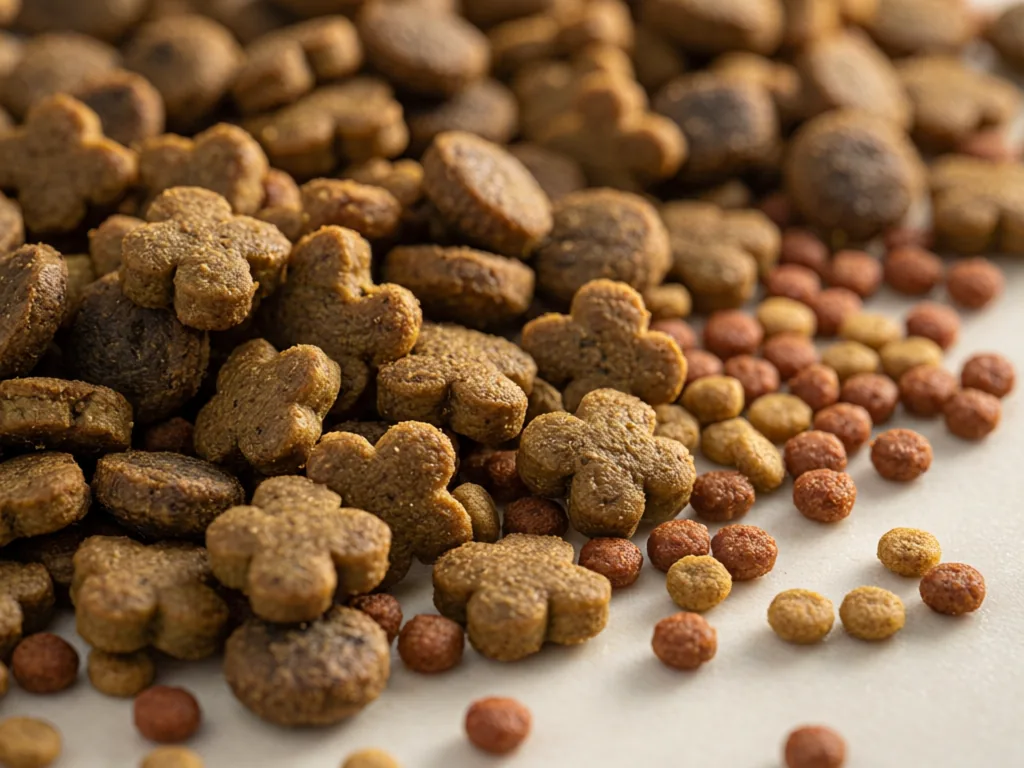
A spec sheet promising high starch content tells you almost nothing about whether your shrimp feed will hold together in water, because the binder in a pellet is not starch — it is gelatinised starch, and raw starch delivers no glue no matter what percentage it is listed at. The tests that actually predict pellet durability and water stability measure two things in sequence: how much of the starch the process manages to cook, and how well the cooked paste holds under water. An RVA pasting curve tells you the first from the material side; a bench pellet test with a soak timer tells you the second from the product side. Neither requires stopping your production line. Here is the chain that connects them, and the two-step screen a buyer can run before ever committing to a trial run.
Why Doesn’t the Spec Sheet Predict Durability?
Because durability is a property of the process, not of the ingredient. In a shrimp diet, starch is the binder, but only after its granules have swollen, burst and flowed into the spaces between protein and fibre particles — which is gelatinisation. Native granules passing through the pellet uncooked are just filler: they sit in the matrix like sand in cold water and wash out the moment the pellet meets a pond. Two meals with identical total-starch percentages on paper can behave completely differently after extrusion, because one starch gelatinises readily at your conditioning temperature and the other resists it and exits the die largely intact.
So the spec-sheet column to distrust is “starch, min %”. The question to ask instead is: at what temperature does this starch swell, how completely does it cook under my conditioning profile, and does the cooked paste stay sticky when it cools in the water? Those are pasting properties, not composition, and the feed buyer has to test them as properties.
What Does the Pasting Curve Tell a Feed Mill?
A pasting instrument — the RVA being the common one — heats a starch-water slurry on a fixed profile, shears it gently, cools it, and records viscosity over time. Read it as a predictor of what the starch will do inside the extruder and inside the pond.
- Peak viscosity reflects how far the granules swell. In a sinking pellet, high peak swelling is what fills the gaps between particles; it is necessary but not sufficient.
- Breakdown is how much viscosity is lost under shear at the holding temperature. A starch that breaks down hard may still bind in the die — the released amylose glues well — but it can starve the paste that survives to the cooler, and it signals sensitivity to over-conditioning.
- Setback is the viscosity recovered on cooling — the re-association of leached amylose. In feed terms this is the paste that firms up around the particles as the pellet leaves the die and cools. Enough setback gives you a skin that holds; too much firms a sinking pellet past what the animal easily digests, so the target depends on the diet and the feeding window rather than on “more is better.”
None of this replaces a pellet test — it narrows the field so the pellet test is not a fishing expedition. The same instrument and the same discipline we use to compare food grades, the counter-match curves approach, applies here: one method, one profile, samples side by side — the same discipline we document for industrial binder applications.
How Do I Screen Two Starches Without a Production Trial?
Two stages, cheap to expensive, and only the second one touches a pellet mill.
Stage 1 — pasting profile on the candidate starches. Run each starch in the instrument under one fixed profile: same concentration, same heating ramp, same shear, same cooling. Record peak, breakdown and setback. Two starches that give visibly different curves at your conditioning temperature are telling you which one will cook to the degree your process demands. The instrument profile tops out below real conditioning temperatures, so read the curve as a ranking signal, not as a simulation of your cooker. A simple iodine-colour check on cooked versus raw qualitative read on how completely each starch gelatinises, and it is a fair addition to this stage. If the curves overlap, you cannot separate them from the bag; move to Stage 2.
Stage 2 — a bench-scale pellet test with one variable changed. Prepare one reference diet — base formula, grind size, conditioning moisture and temperature all fixed. Then run that diet with starch A and, unchanged in every other respect, with starch B, one at a time, under identical pelleting settings. Three measurements come out of this bench run, and they answer different buyer questions:
- PDI (pellet durability index) — tumbled pellets, sieve, weigh the intact fraction. It answers: do the pellets survive handling, pneumatic lines and bagging without fines?
- Water stability / soak loss — weigh a pellet, submerge it in still water on a timer, and watch. For shrimp feed the clock matters more than the machine: a pellet that leaches mush in the first minutes wastes purchased feed and fouls the pond bottom, so water stability is an economics question, not a cosmetic one (for the wider production context, the FAO aquaculture portal). Record the time the pellet holds its shape and the mass lost to water, at a realistic depth and temperature.
- Fines and surface quality — visual plus weigh-in. Cracked skins and dust are early warnings that the binder paste did not set continuously around the particles.
The discipline that makes the comparison real: the only difference between runs is the starch. Same die, same temperature, same moisture, same cooling. If conditioning changes too, you have tested two different processes and learned nothing about either starch. The same logic is what makes a supplier’s RVA curves comparable in the first place, and it is why a supplier who cannot run your matrix, in your conditions, is selling you a bag of numbers rather than a binder decision.
Which Starch Property Wins Under Water?
Different feed problems, different properties. Match the lever to the failure:
- Pellet falls apart in handling (low PDI) — the paste is under-cooked or under-swollen. Raise conditioning temperature or moisture within what the diet tolerates, or move to a starch whose pasting peak arrives inside your process window.
- Pellet survives handling but disintegrates in water within minutes — swelling without set. The binder needs setback, or the diet needs a binder that leaches amylose enough to re-associate on cooling. This is where a more cook-prone starch outperforms a tougher, higher-gelatinisation native.
- Starter diets in cold water — the pond is cold and the animal is small; the pellet must hold for hours, not minutes. Look for pastes that set firm at low temperature; some physically modified (pregelatinised) binders are engineered exactly to swell and set in cold mash conditions, which no degree of native-starch cooking achieves without steam.
Note what is absent from that list: “more starch”. You cannot out-of-percent the process. A correctly gelatinised smaller share of binder beats an under-cooked larger share, every time, in every soak test where the water decides the answer.
What Should a Feed Buyer Ask the Supplier For?
The right request list for an aqua feed program is short, and none of it is a composition sheet:
- A pasting curve of the candidate starch, with the method stated — instrument, concentration, ramp — so your bench stage 1 can reproduce it.
- Curves on your matrix or at least on your conditioning profile, not just a default laboratory endpoint in distilled water.
- Two bench pellet runs you can watch or witness: PDI and a soak timer, reference diet constant, starch as the only variable.
- A per-lot COA and retained samples so the curve you qualified stays the curve you buy; batch-to-batch drift in pasting behaviour is exactly the drift that ends up as pond-side waste.
Ask for the process, not the number. A supplier who can show you peak, breakdown and setback on a fixed method has a binder; a supplier who only states “starch content” has an ingredient. The difference between the two shows up at the feeding tray, where the shrimp decide.
FAQ
Does higher starch percentage always improve pellet durability?
No. Percentage only supplies the binder; gelatinisation converts it into glue. Past a point, extra uncooked starch is filler that dilutes the binder share and leaches into the water.
What single number predicts water stability best?
No single number does it alone. The best predictor pairs setback on the pasting curve with a bench soak timer run under your own conditioning profile, and you read the two together. Anyone selling you one number is selling a shortcut that fails at the pond.
Do pregelatinised starches bind better than native ones?
They bind instantly in cold water because they are already cooked — useful for starters and cold-conditioned mash. That same instant cold set is a handicap in hot-conditioned extrusion where you want the paste to develop in the die, not disperse in the mixer. Different tools, different processes.
Can a soak test replace a PDI run?
No — neither replaces the other. They answer different failure modes: handling losses versus pond losses. A screen that runs only PDI misses the pellet that survives the bag and dissolves in the water.
Will the process or the binder matter more?
Process sets the ceiling, the binder chooses the curve inside it. The buyer’s decision order: define your conditioning reality, then let the pasting profiles pick candidates, then let the bench pellet run decide.
Tell GFMStech your conditioning temperature, die and soak target, and we will pasting-profile candidate binders against that profile — the same application logic we apply across food and feed systems, with curves you can verify on your bench before a single production ton is committed.