The method decides brine pickup before the formula does. Injection puts a measured solution straight into the muscle through needles; tumbling lets the meat soak and work the solution in over hours in a rotating drum. Both raise yield and improve water retention, but they get there through different mechanics – pressure versus time – and each one asks a different job of the binder in the brine. Most plants running into trouble with meat injection vs tumbling are not choosing the wrong method; they are running the right method with a starch that cannot hold up in it.
What is the difference between injection and tumbling in meat processing? Injection delivers brine into whole muscle through needles under pressure, so pickup is fast and measurable. Tumbling puts meat and brine in a rotating drum, where hours of mechanical work plus vacuum improve water retention, tenderness and binding. Injection suits whole muscle and bone-in cuts; tumbling suits formed products, hams and cuts where texture development matters. Many lines run injection first and tumbling after.
The Method Decides Brine Pickup First
Pickup targets start with the method. An injector meters a percentage of brine into the meat on the way past the needles, and the operator reads that percentage off the line. A tumbler cannot state pickup in one pass; water retention builds as the drum turns, and the outcome depends on time, vacuum level, rotation speed and the ratio of meat to brine. The two systems fail in different ways, and troubleshooting has to start from which one is on the line.
| Point | Injection | Tumbling |
|---|---|---|
| How brine enters | Needles deliver solution into whole muscle | Meat absorbs and exchanges brine in a rotating drum |
| Speed | Minutes on the line | Hours per batch, often with vacuum |
| Fits best | Whole muscle, bone-in, large cuts | Formed cuts, hams, small pieces, surface treatment |
| Binder role | Keeps injected water in place through cook | Binds water during extended mechanical work |
The Needle Path
An injector works by displacement. Needles carry the brine into the muscle at defined points, and the meat holds that water only if the solution stays where it was placed. That makes the binder’s behavior inside the muscle – not in a beaker – the deciding factor. Once incorporated by injection or tumbling, cook-up starches become distributed in the meat matrix, sitting between meat fibrils when the brine was injected and worked in, as described in the review of starch performance in meat. Water that stays bound to the starch between the fibrils stays in the product; water that does not becomes purge in the bag.
The published case for working the meat is solid. Tumbling, homogenizing or proper mixing enhances dispersion of ingredients and raises ionic strength and pH, leading to increased product yield, improved water retention, tenderness, juiciness and better binding of meat chunks, according to a review of processing effects on meat quality. The same review reports that vacuum tumbling buffalo meat at 0.4 bar for 3 hours at 11 rpm improved extraction of salt-soluble proteins and enhanced binding and cohesiveness compared with aerobic tumbling for the same duration.

The Drum Path
A tumbler works by repetition. Every rotation drops, folds and kneads the meat against itself and the drum wall, and over a few hundred rotations the muscle fibers loosen, the brine penetrates, and protein extraction starts. Vacuum helps by pulling air out of the tissue so the brine has somewhere to go. Time is the operator’s main lever here – and the literature even suggests less of it can be worth more in some sequences: reducing the duration of tumbling before injecting has been reported to enhance yield and tenderness of roast beef (Boles and Shand, 2002, cited in the same review).
What Each Method Asks of a Binder
The binder conversation changes with the method because the two systems place different demands on the starch. Injection wants a powder that dissolves fully at cold brine temperature and stays in suspension. Tumbling wants a starch that keeps binding after hours of mechanical work and does not break down before the batch finishes. One grade rarely tops both lists, which is where our custom thickener systems earn their place.
| Demand | Injection brine | Tumble process |
|---|---|---|
| Hydration | Cold solubility so the powder dissolves in the brine tank | Hydration during tumbling, often at chilled temperature |
| Shear exposure | Low to moderate – pump and needle passage | High and sustained – hours of drum work |
| Water retention | Holds injected water through cooking and chill | Binds purge released during extended mixing |
| Process temperature | Must gelatinize within the final cook profile | Must survive cook and often a second chill cycle |
Needle-Friendly Solubility
An injector is unforgiving about undissolved powder. A lump that passes the tank screen can plug a needle, and a plugged needle leaves a column of the cut that never gets its brine – visible at slicing as a pale streak. That is why cold water soluble grades anchor injection brines: they hydrate fully in the tank at chilled temperature, before the pump sees them. The dissolved state matters on the other side of the needle too, because the starch has to start holding water as soon as it meets the muscle, not an hour later.
Hours of Shear in the Drum
Tumbling is a low-intensity shear environment compared with a bowl chopper, but it runs for hours instead of seconds, and that changes what the binder has to survive. A starch that thins out under sustained mechanical work stops binding partway through the batch, and the later rotations have nothing left to hold. Cross-linked chemistry is what gives a grade its staying power; a native or lightly modified starch can lose viscosity over the same span. Thermal fit matters just as much: the most important criterion in choosing a starch for meat products is its gelatinization temperature, which must correspond with the temperatures the product actually reaches during thermal processing, according to the starch-in-meat review. A grade that gels late binds less water at the cook step, no matter how well it survived the drum.
Where Each Method Breaks Down
Failure modes are specific, and they point straight at the binder. Our technical team sees the same three problems across meat and aquatic projects, and each one maps to a method and a grade choice.
The Retort Moisture Problem
Standard starches break down at retort temperatures above 120C. The granule loses its structure, bound water releases back into the product, and the effect on the plant floor is dry texture, shrinkage and lower cooked yield. On an injected product this shows as purge in the tray after sterilization. The fix is a cross-linked grade that keeps holding water through the retort, which is why E1442 (hydroxypropyl distarch phosphate) is our standing recommendation for retort moisture retention – it is freeze-thaw stable and carries moisture through 121C and above.
The High-Shear Binding Problem
Emulsification and fine grinding punish weak binders. Under sustained mechanical shear the starch structure degrades, and the binder loosens precisely when it is supposed to be holding the emulsion together. The line reads it as loose texture, casing defects and batch-to-batch inconsistency. E1412 (distarch phosphate) covers this case: its cross-linked structure withstands the shear of sausage emulsification and grinding, so the binder stays intact through the chopper and the pump.
The Pellet Water-Stability Problem
Feed pellets face the opposite of a cook-loss problem: they have to survive extrusion and then stay intact in water long enough for the fish to eat them. A weak binder crumbles and releases nutrients into the pond before feeding happens. Extruded pregelatinized starch is the grade for this job. It brings high swelling power and pellet binding, and the pellets hold their shape in water instead of dissolving into the tank.
Grades That Hold Under Each Method
Mapped to the two methods, the recommended grades split cleanly. Injection and tumbling both lean on cross-linked chemistry where the product cooks hard, and on pregelatinized grades where the binding has to happen fast and cold. Three of our series cover the whole meat and aquatic range: P-02 pregelatinized grades for cold-water instant binding, P-03 cross-linked grades around E1442 and E1412, and P-06 thickener systems built as complete meat-specific blends.
The two headline codes deserve their track record. E1442 (hydroxypropyl distarch phosphate) and E1412 (distarch phosphate) are the backbone of the P-03 range, and E1442 and E1422 compared shows how the codes split retort duty from acid duty elsewhere in the catalog. The full range sits alongside them in our E-code grades, and the outcome for a given product line is mapped on the meat and aquatic starch solutions page we build each project against.
Matching the Method to the Product
Product format usually settles the method before engineering opinion does. Whole muscle with intact structure can take a needle; small pieces and trim cannot. A formed product needs the binder to glue pieces into a sliceable log, which is a tumbling job. Surimi and feed pellets are binding problems of a third kind. The matrix below is how those cases usually resolve.
| Product | Usual method | Grade direction |
|---|---|---|
| Whole muscle and bone-in cuts | Injection, often with short tumbling after | Cold-soluble binder plus cross-linked starch for the cook |
| Formed and restructured cuts | Tumbling or vacuum tumbling | Shear-tolerant binding with texture development |
| Sausages and emulsified meats | Bowl chopper, no tumbling | High-shear grades such as E1412 |
| Retort hams and canned meats | Injection then tumbling | E1442 for moisture retention through 121C |
| Surimi fish balls and aquafeed | Mixing and forming or extrusion | Extruded pregelatinized grades for binding |
Whole Muscle and Bone-In
Whole cuts take brine through needles and hold it in the muscle structure itself. The binder’s job is retention, not texture building, because the bite should still read as intact muscle. That pushes grade selection toward cold-soluble and cross-linked starches that hold injected water through the cook without adding a pasty mouthfeel.
Formed and Restructured Cuts
Formed products invert the priorities. Here the starch has to build cohesiveness across piece surfaces, and the process is nearly always tumbling because the drum works the surfaces the binder has to glue. The grade needs shear tolerance first and cold solubility second, since a tumbler keeps working the matrix for hours after hydration.
Surimi Fish Balls and Aquafeed Pellets
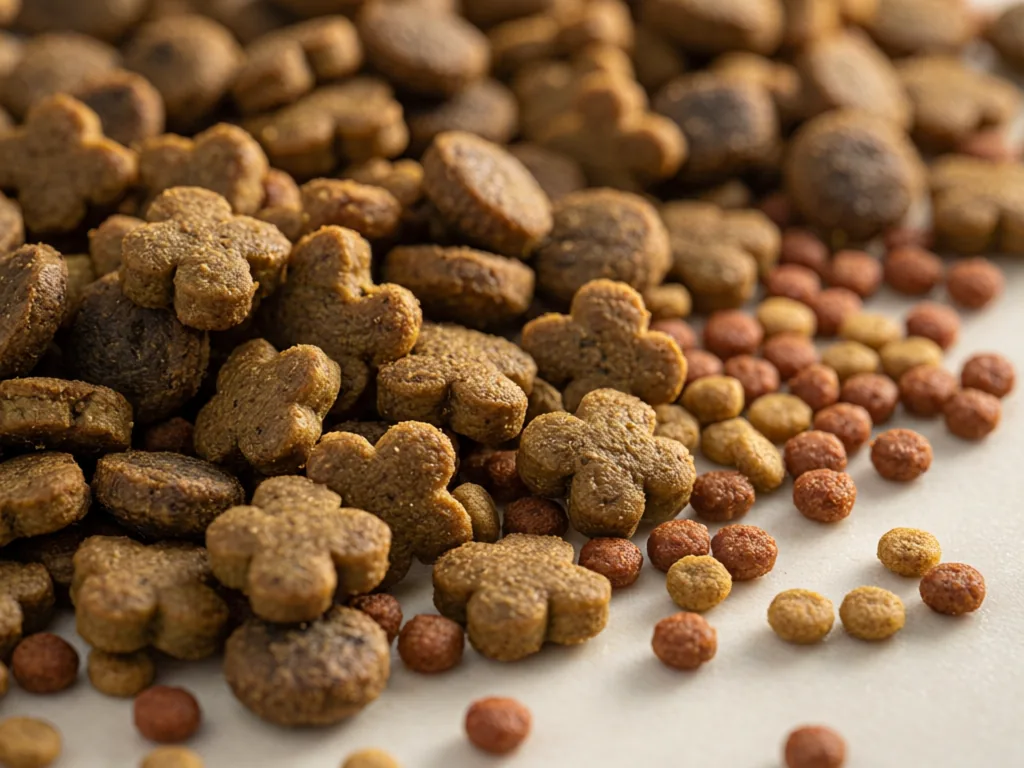
Aquatic products run the binding job under different physics. Surimi fish balls need gel strength and a clean bite; feed pellets need survival through extrusion and then water stability in the pond. Extruded pregelatinized grades cover both cases, and they are why the P-02 series leads our aquatic recommendations rather than the cross-linked codes that dominate the meat side.
When a Custom Blend Beats a Single Grade
There is a pattern across meat projects: the injection side wants cold solubility, the cook side wants retort stability, and a single grade compromises on one of them. That is where a blend outperforms any catalog code. The food thickener selection guide maps the same choice across starch, gums and blends. One custom blend can replace three separate additives, which shortens the bill of materials, removes dosing steps and stabilizes the supply chain at the same time – the plant stops juggling three arrival schedules for one functional job.
| Consideration | Single grade | Custom blend |
|---|---|---|
| Method fit | Suits one side well, compromises on the other | One system engineered for the whole sequence |
| Additive count | Separate starch, stabilizer and phosphate duties | One ingredient covers combined functions |
| Trial path | Off-the-shelf sample, limited tuning | Two to three prototypes benchmarked in the RVA lab |
Phosphate-Reduction Water Retention
Clean-label pressure lands directly on the brine. Water-holding capacity is a central quality challenge in reduced-salt meat products, and improving protein-water interaction and gelation raises the water-holding capacity of the final product, as reported in the reduced-salt meat review. Starch-based retention systems work alongside or replace phosphate functions where E450 and E451 use is being reduced – the same yield focus with a shorter declaration.
The Four-Step Path to a Blend
The process is fixed and fast. The first step is consultation: the target product, its processing conditions – temperature, pH and shear – and the texture target. The second is formulation development, where the R&D team benchmarks two to three prototypes in the RVA lab until the spec aligns; for fully custom formulations a blend proposal typically lands within 5 business days. The third is sample testing with a free 25 kg trial batch shipped inside 48 hours, with reformulation free until the blend matches. The fourth is production, where every shipment carries a per-batch COA so the formula runs the same in month twelve as in week one.

One Guardrail on Numbers
There is one figure from the literature worth knowing, with its label firmly attached. The classical industrial method of marinating meat with starch – summarized from the patent work of Halden, Mathiesen and Proctor, 1992 – used starch at 0.5 to 5 percent by meat weight, with a succession of injection and vacuum tumbling. That is patent literature, not a recommendation for your line. The right level for your brine depends on the full recipe and the process conditions, and it is set through the trial, not copied from a range.
How GFMStech Runs a Meat Trial
GFMStech is a modified starch manufacturer working from a single Suzhou base with four production lines and 25,000 tonnes of annual capacity, exporting to more than 30 countries under ISO 9001:2015, ISO 22000 and ISO 14001 certificates plus HALAL and KOSHER certificates. The meat and aquatic projects run through the application R&D center, and the trial path is built so the first container is never the first test.
Send the targets – product format, method, process temperature, pH, shear and the texture you want – and the work starts before a purchase order exists. The design-for-manufacture analysis tests feasibility while the RVA lab benchmarks the blend against your process profile. A free 25 kg trial batch ships within 48 hours, there is no MOQ, and the blend can be reformulated free until it matches. When you are ready, first orders ship in 10 to 15 working days and repeats in 7 to 10, and reading a COA before your trial shows exactly which rows to check when the first bags arrive.

Bring your line parameters to the first conversation: the method, the process temperature, the shear in the drum or chopper, and the texture target. The blend you get back is benchmarked on an RVA against those numbers and shipped as a free 25 kg trial batch – so the meat and aquatic starch solutions are proven on your line before the first order.
Meat Injection and Tumbling FAQ
Is Injection or Tumbling Better for Ham?
Most hams use both. Injection delivers the brine into the whole muscle quickly and measurably, then tumbling improves retention, tenderness and binding over a few hours in the drum. The binder has to serve both stages – cold solubility for the brine tank, cross-linked stability such as E1442 for the cook – which is why hams are a common custom-blend project.
What Starch Is Used in Meat Brine?
Two families dominate. Cross-linked starches such as E1442 (hydroxypropyl distarch phosphate) and E1412 (distarch phosphate) hold water through retort and shear, which suits cooked and emulsified products. Pregelatinized grades dissolve at cold brine temperature and bind immediately, which suits injected and tumbled lines that start cold. Blends combine the two when one method spans both conditions.
Can You Inject Starch into Meat?
Yes, and it is routine in the industry. The classical method summarized from patent literature used 0.5 to 5 percent starch by meat weight with injection followed by vacuum tumbling. The practical requirement is full solubility in the brine tank: undissolved powder plugs needles and leaves unbrined streaks. Cold water soluble pregelatinized grades are built for exactly this point.
Why Does Injected Meat Lose Water When Cooked?
In most cases the starch cannot hold the injected water at the temperature the product reaches. Standard starches break down at retort temperatures above 120C, releasing bound water as purge and reducing cooked yield. A cross-linked grade such as E1442 is built to keep holding water through 121C retort and freeze-thaw cycles, which keeps the injected moisture in the product.
Can Tumbling Replace Injection?
For formed and restructured products, often yes – the drum works brine into pieces and builds the surface binding the product needs. For whole muscle and bone-in cuts, no: tumbling alone is slow and shallow compared with needles, which is why those lines inject first and tumble after. The choice follows product format more than preference.
What Thickener Holds Brine in Meat?
Modified starches are the working thickeners in modern brines, usually cross-linked types for cooked products and pregelatinized types for cold processes. Where reduced phosphate or reduced salt is the goal, starch-based retention systems take over part of the water-holding duty, which is the core challenge in reduced-salt meats. Our custom thickener systems blend those functions into one ingredient.