Thickening is a fight over water. Every starch, gum and hydrocolloid wins that fight with a different mechanism. A formula that looks right on paper fails on the line when the mechanism meets the wrong temperature or pH. Choosing a food thickener is a materials decision before it is a purchasing decision. This guide sorts the families by what they actually do, maps them to product categories, and ends with the three numbers that start a working sample request.
How do manufacturers choose a food thickener? Start with the process, not the brand. The temperature the product reaches, the pH it holds, the shear it passes and the cold chain decide which family can do the job. The label and the target texture narrow it further, and a lab benchmark proves the choice before volume.
What the Process Decides First
A thickener brief rarely arrives as an ingredient question. It arrives as three numbers: the target viscosity at serving, the processing temperature, and the pH the product will hold. Those inputs eliminate most of the field before price enters the conversation. A starch that behaves at room temperature can die at 120C retort, and a gum that holds at neutral pH can thin in an acidic tomato system.
Systems built to a target viscosity, temperature and pH are what thickener systems means in practice. The engineering starts from the three numbers, not from a catalog page.
The Three Inputs That Decide
Processing temperature sets the ceiling. Anything crossing 120C retort, UHT or hot-fill needs cross-linked chemistry that holds its granule structure under heat. The pH window sets the chemistry: acid systems near pH 3 to 4 demand esterified, acid-stable starch, while neutral systems leave more options open. Shear decides the last cut, because a product that passes a high-shear pump or homogenizer will lose texture that a gentler line keeps. Ask any formulator which input matters most and the honest answer is whichever one your process pushes hardest.
The Three Families That Thicken
Thickeners group under four headings in the FDA-facing taxonomy: starches, gums, pectin and cellulose derivatives. For a working decision they collapse into three families: starch, gums, and the specialist hydrocolloids such as pectin and cellulose derivatives. Each family wins different briefs, and each has a failure mode worth knowing before the trial.
Native Starch and Modified Starch
Native starch does one job well: it cooks up, thickens and then ages. Heat, shear and acid break its granule down, and retrogradation firms the texture over shelf life. Modified starch is the engineered version of the same material, altered at the molecular level to thicken consistently under heat, shear and freeze-thaw cycles. That consistency is why modified starch carries most manufactured-food briefs.
| Family | What it brings | Where it fails | Label note |
|---|---|---|---|
| Modified starch | Consistent thickening under heat, shear and freeze-thaw | Needs the right grade for acid or retort duty | Food starch-modified or E-number |
| Native starch | Simple, familiar thickening for gentle processes | Breaks down under heat, shear and acid | Declared by its own name |
| Gums | Cold-water function and viscosity at low concentrations | Texture limits at higher use levels | Declared by name; GRAS examples |
| Pectin and cellulose | Gels, films and structure for specific systems | Narrow fit; needs a matching process | Declared by name |

Why Modified Starch Leads Most Briefs
Modified starch wins the count of manufactured-food formulas, and the reasons are operational. It thickens consistently under heat, shear and freeze-thaw cycles, and it comes as a deep ladder of grades rather than a single product. The starch structure is chemically altered to resist heat and thicken under extreme conditions, which is exactly what a retort line or a hot-fill sauce asks for.
The ladder is what buyers actually work with. GFMStech ships ten E-code variants, from E1401 for low-viscosity confectionery work to E1450 for emulsifying duty in beverages, each with a stated function and primary application. The two most requested codes split the heavy lifting. E1442 handles freeze-thaw stability and E1422 handles acid and hot fill. E1442 and E1422 are worth comparing side by side before a brief goes to quote. The base material behind any E-code is a second decision, and the tapioca side of that base choice is a story in itself.
What Gums Change in a Formula
Gums do the jobs starch handles poorly, and starch does the jobs gums handle awkwardly. A hydrocolloid supplier’s guide to FDA approved food thickeners maps that division of labor cleanly.
What Xanthan and Guar Do
Xanthan gum delivers high viscosity at low concentrations and holds up in acidic, salty or frozen conditions. It adds body and prevents separation without needing heat to activate, which makes it the default for cold-mix and gluten-free systems. Gellan gum forms clear, heat-stable gels and suspends particles in low-sugar or low-pH drinks, where clarity matters as much as texture. Guar gum hydrates quickly in cold water and builds viscosity fast at a cost that keeps it in dairy, sauces and bakery fillings. The trade-off sits in the mouthfeel: gum systems read smooth and slightly elastic, and they thin under shear in ways a starch paste does not.

Matching the Family to the Product
Category patterns beat theory. The table below maps the five product groups that drive most thickener briefs to the family that fits best, with the reason stated in process terms.
| Product category | Family that fits | Why it fits |
|---|---|---|
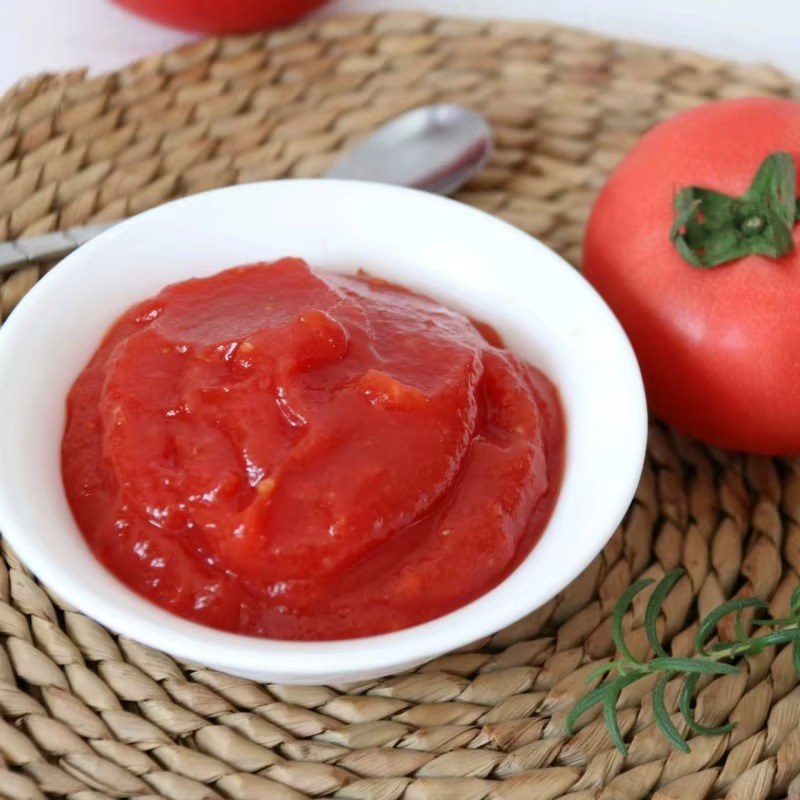
| Acid sauces and ketchup | Cross-linked modified starch | Holds viscosity across pH 3 to 7 |
| Frozen ready meals and sauces | Freeze-thaw modified starch | 5 cycles with no syneresis or weeping |
| Meat, surimi and fillings | Modified starch system | Binds water and protects cooked yield |
| Beverages and syrups | Xanthan or medium-viscosity starch | Suspends pulp without grit or heat |
| Dairy desserts and gels | Gellan or modified starch | Clear, heat-stable structure |
Two rows deserve a footnote. Acid sauces split the field fastest. Tomato systems punish a fragile granule every hour it sits on the shelf, and acid-side benchmarks for E1422 in ketchup show how the test work runs. In meat, the thickener does not just thicken. It holds water through cooking, and how injection and tumbling decide yield explains where the loss happens when the system is wrong.
Label Rules Behind Each Choice
Labels follow chemistry, and the two big markets read differently. In the United States, 21 CFR 172.892 defines food starch-modified by the treatment categories it permits: acid modification, bleaching, oxidation, esterification, etherification, or combinations of those treatments. In the EU the same chemistry appears as an E-number. Pregelatinized starch takes the simpler road: with no chemical treatment applied, it is declared by its own name, which is why clean-label reformulations often start there.
Gums travel under their own names too. Xanthan gum, guar gum and pectin sit on the common GRAS list, meaning they hold a long safety record rather than a petition. The FDA standard behind every approved thickener is reasonable certainty of no harm, and post-market monitoring keeps the file open after approval. For a buyer, the practical step is simple: match the label target to the family before the trial. A chemistry swap late in development costs more than a base swap early.
Cost Math Beyond the Price Per Kilo
Price per kilo is the wrong number to optimize. The useful unit is cost per finished tonne. It multiplies the use level by the price, then adds everything a failed formula costs: a wasted batch, a delayed launch, a reformulation cycle. Across GFMStech thickener systems the typical usage band runs 0.5 to 4 percent depending on the application and the target body. Formulation support sets the level, not a rule of thumb.
The hidden cost sits in reformulation. A thickener that misses the spec does not fail loudly; it fails at the sensory panel, at the fill line or in month three on the shelf. That is also where blending earns its place: one blend can replace three separate additives, which shortens the bill of materials and removes dosing steps from the line.
Test Before You Commit Volume
Three Numbers Before the First Quote
Selection work gets fast once three numbers are on the table: target viscosity, processing temperature and pH. Send those, plus the process conditions around them – shear, cold chain and shelf life – and the R&D team can match a system from the first reply. The laboratory then develops 2-3 blend prototypes and benchmarks viscosity behavior in the RVA lab until the spec aligns. You test, the lab iterates, and reformulation stays free until it matches, with no hidden charges.
The trial economics are built for first-time buyers. A free 25 kg trial batch ships within 48 hours, there is no MOQ, and a per-batch COA covering viscosity, moisture and whiteness arrives with every shipment. From the approved trial the program scales to full container loads under the same specification. That combination – benchmark, trial, documented batch – is the difference between a food thickener supplier and a development partner. GFMStech runs the whole path from one Suzhou base as a modified starch manufacturer: 4 production lines and 25,000 tonnes of annual capacity. Custom blending covers the systems that no stock grade reaches.
Send three numbers – target viscosity, processing temperature and pH. Our R&D team will match a system from the thickener systems range, benchmark it on an RVA, and ship a free 25 kg trial batch within 48 hours.

Food Thickener Questions from Buyer Teams
What Is the Most Common Food Thickener?
Modified starch carries more manufactured-food formulas than any other thickener, because it thickens consistently under heat, shear and freeze-thaw cycles and comes as a deep ladder of grades. Cornstarch and tapioca cover simple cooking, xanthan gum leads cold-mix and gluten-free systems, and guar gum anchors cost-sensitive dairy and bakery fillings.
Are FDA Approved Food Thickeners Safe?
The FDA holds every thickener to the same standard: reasonable certainty of no harm. Some qualify as GRAS, including xanthan gum, guar gum and pectin, and the rest pass through a food additive petition with toxicology data. Post-market monitoring adds a second layer. Used as intended, the approved families carry decades of safety data.
What Is the Difference Between Thickener and Stabilizer?
A thickener builds viscosity; a stabilizer keeps a system from changing. In practice the two jobs overlap, because most stabilizers also thicken and most thickeners also protect texture. That is why suppliers ship blended systems rather than single ingredients: one blend can thicken a sauce, hold its water in place and carry it through the cold chain.
How Much Thickener Does a Formula Need?
It depends on the application and the target body. Across GFMStech thickener systems the typical band runs 0.5 to 4 percent, and the exact level is set by formulation support rather than a rule of thumb. The level follows the target viscosity, the process and the co-ingredients, so the lab sets it per brief.
What Is the MOQ for Thickener Systems?
There is no MOQ. GFMStech starts buyers on 25 kg trial batches for line validation, with free samples shipped within 48 hours and a per-batch COA. From the approved trial the program scales to full container loads, and the viscosity specification stays the same because every batch is RVA-verified.